
If dried dough is mostly starch held together by protein, then breaking it down is really a chemistry question. Which ingredients can take starch and protein apart, and which ones just make you feel like you are doing something?
Here is what works, what helps a little, and what does not, including what goes into our own bottle.
Quick recap: what you are up against
White flour is roughly 70 to 75 percent starch, and the gluten proteins form the network that holds it all together. There is very little fat. Once dough dries, that starch and gluten set into a hard film. Anything that is going to break dough down has to deal with those two things. There is more detail in What Is in Dough?
Ingredients that actually break dough down
Amylase: the starch cutter
Amylase is an enzyme that cuts the long chains of starch into much smaller sugars. Your own saliva contains it, which is why bread starts to taste sweet if you chew it for a while. In a cleaner, amylase takes apart the starch that makes up most of the dried film, so the film loses its strength and its grip.
Protease: the gluten relaxer
Protease is an enzyme that breaks down protein. Gluten is protein, so protease unpicks the network that holds the starch in place. Amylase on its own can leave a gluten skeleton behind. With protease alongside it, both halves of the residue come apart.
Other enzymes
Bakers and food makers use other enzymes too. Xylanase, for example, breaks down the arabinoxylans in flour fibre that make rye and wholemeal doughs extra sticky. For everyday dried white or sourdough residue, though, amylase and protease do most of the work.
Ingredients that help, but do not break it down
Warm water
Water rehydrates dried dough, softening it so other ingredients can reach it. Warm is better than cold because it speeds things up. Very hot water is worse, because it turns starch gummy and can stop enzymes working. Enzymes are proteins themselves, and too much heat makes them lose their shape.
Gentle surfactants
Surfactants help water spread out and get underneath residue, then carry the loosened bits away. They do not break down starch or gluten, but they make the rinse faster and cleaner. Mild, plant-derived ones do this without stripping your hands.
Baking soda
Bicarbonate of soda is a gentle abrasive. It can help scrub softened dough off, but it is still scrubbing. It does not dissolve starch or gluten.
Ingredients that do not do much
- Dish soap. Made for grease, and dough has very little of it.
- Vinegar. Dilute acetic acid. Great on limescale, not on starch or gluten. See Enzyme Cleaner vs Dish Soap vs Vinegar for Dried Dough.
- Salt. Coarse salt can act as a scrub, but it does nothing chemically to dried dough.
What is in After Dough, and why
Our formula follows the same logic. These are the ingredients doing the work, and the job each one has:
- Amylase breaks down the starch.
- Protease breaks down the gluten.
- Potassium cocoyl glycinate, a mild coconut and amino acid cleanser, helps lift the loosened residue.
- Coco-glucoside, made from coconut and fruit sugar, helps it rinse away without leaving a film.
- Glycerin helps protect hands that are in dough several times a week.
To use it, add a couple of pumps to warm water in the bowl or jar, swirl, leave it for about ten minutes, then rinse.
What not to do
- Do not use boiling water with an enzyme cleaner. Too much heat stops enzymes working.
- Do not mix cleaning products hoping for a stronger result. Some combinations are dangerous, and it will not help with dough.
- Do not count on vinegar or extra soap to do an enzyme's job.
Frequently asked questions
What enzyme breaks down dough?
Two do most of the work. Amylase breaks down the starch and protease breaks down the gluten. Together they take dried dough apart so it rinses away.
Does vinegar break down dough?
Not really. Vinegar dissolves mineral deposits like limescale, but it has little effect on starch or gluten at kitchen strength.
Does baking soda dissolve dough?
No. It works as a gentle scrub on dough that has already softened, but it does not break starch or gluten down.
Can I use an enzyme cleaner in hot water?
Use warm water. Enzymes work faster in warmth, but very hot water can stop them working.
The right ingredients for the job. After Dough pairs amylase and protease with gentle plant-based cleansers, so dried dough lets go and rinses away.
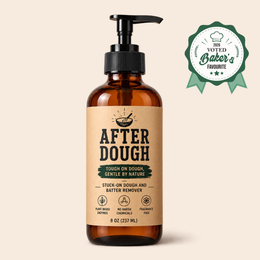
AFTER DOUGH
A plant-based enzyme cleaner that dissolves dried dough so you can stop scrubbing.
Bake more. Scrub less.
After Dough is the plant-based enzyme cleaner built for sticky dough. Skip the overnight soak and let the formula do the work.
Try After Dough