Every kitchen already has dish soap and probably a bottle of white vinegar. So it is fair to ask why dried dough needs anything else. The answer is that neither of them is built for what dough actually is.
Dried dough is starch and gluten, not grease
When flour meets water, glutenin and gliadin link into gluten, a stretchy protein network, wrapped around starch granules. As it dries, the starch sets and the gluten tightens into a hard skin that grips every pore in the surface.
That is a completely different problem from a greasy pan, and it needs a different tool.
Dish soap
Soap works by surrounding fat molecules so water can carry them away. That is genuinely clever, and useless here. Starch and gluten are not fats. Soap will help lift dough that is already softened and loose, but it does nothing to break the residue down. That is why a crusted mixing bowl survives a hot soak and a hard scrub while a greasy pan comes clean in seconds.
Verdict: fine as the final wash. Not the thing doing the work.
Vinegar
Vinegar is dilute acetic acid. It dissolves mineral deposits, which is why it is good on limescale and kettle scale. Acid does not meaningfully break down starch or gluten at kitchen strength and temperature.
It also leaves a smell you would rather not have near a sourdough starter.
Verdict: right tool, wrong job.
Enzyme cleaner
Enzymes are biological catalysts that each target one specific type of molecule. Amylase breaks down starch. Protease breaks down protein, which is what gluten is. Put both in a cleaner and the residue is taken apart at the molecular level rather than scraped off.
That is the whole idea behind After Dough. One pump in warm water, about ten minutes, and the dough loosens and rinses away on its own. The enzymes do what scrubbing was trying to do by force.
Verdict: the only one of the three actually aimed at dough.
Side by side
- Breaks down starch: enzyme cleaner only.
- Breaks down gluten: enzyme cleaner only.
- Removes grease: dish soap.
- Removes mineral scale: vinegar.
- Needs scrubbing: soap and vinegar, yes. Enzyme cleaner, no.
- Safe around a starter jar: enzyme cleaner and unscented soap, rinsed well.
What not to do
- Do not mix vinegar with other cleaners hoping to boost it.
- Do not use boiling water on raw dried dough. Heat can set the gluten and make it harder to shift.
- Do not scrub coated or anodised bowls with metal. Scratches give the next batch of dough more to grip.
Frequently asked questions
Does dish soap remove dried dough?
Only indirectly. Soap targets fats, and dough is starch and protein. It helps wash away dough that has already been softened, but it does not break the residue down.
Does vinegar dissolve dough?
No. Vinegar dissolves mineral deposits like limescale. It has little effect on starch or gluten at normal kitchen strength.
What actually dissolves dried dough?
Enzymes. Amylase breaks down the starch and protease breaks down the gluten, so the residue comes apart and rinses away instead of needing to be scraped.
Is an enzyme cleaner safe for food surfaces?
A food-grade enzyme cleaner is formulated for exactly this, and rinses clean. Always rinse well, as you would with any cleaner.
Stop fighting chemistry with elbow grease. After Dough is a plant-based enzyme cleaner built for starch and gluten, not grease.
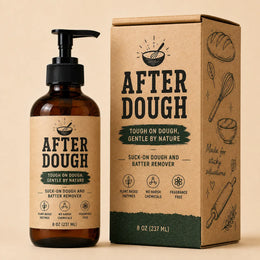
AFTER DOUGH
A plant-based enzyme cleaner that dissolves dried dough so you can stop scrubbing.
Bake more. Scrub less.
After Dough is the plant-based enzyme cleaner built for sticky dough. Skip the overnight soak and let the formula do the work.
Try After Dough